
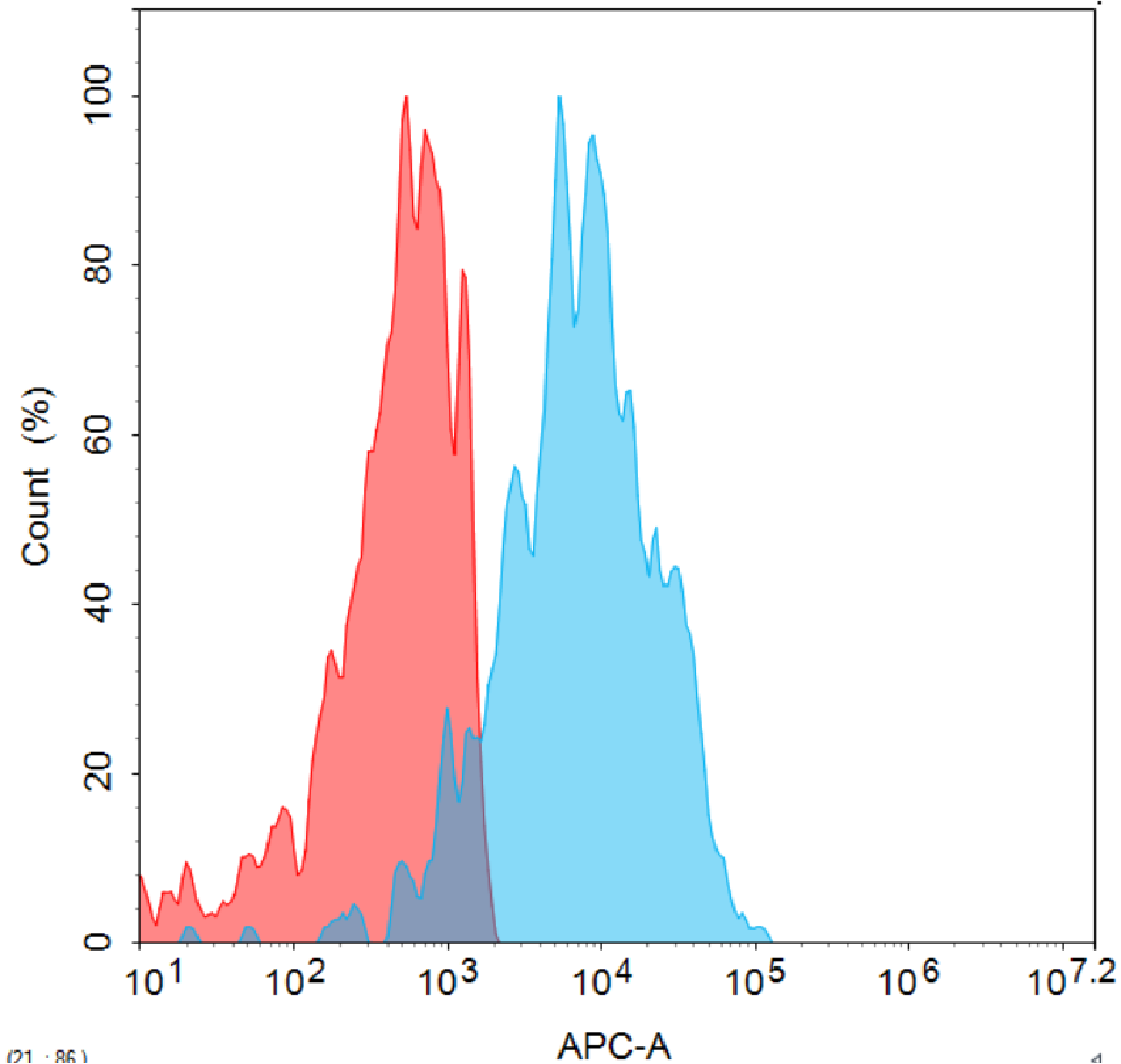
| Clone ID | 1F7 |
|---|---|
| Target | |
| Immunogen | PME100652 |
| Synonyms | APO-3;DDR3;DR3;GEF720;LARD;PLEKHG5;TNFRSF12;TR3;TRAMP;WSL-1;WSL-LR |
| Host Species | Rabbit |
| Description | Anti-TNFRSF25 antibody(1F7), IgG1 Chimeric mAb |
| Delivery | In Stock |
| Uniprot ID | Q93038 |
| IgG type | Rabbit/Human Fc chimeric IgG1 |
| Clonality | Monoclonal |
| Reactivity | Human |
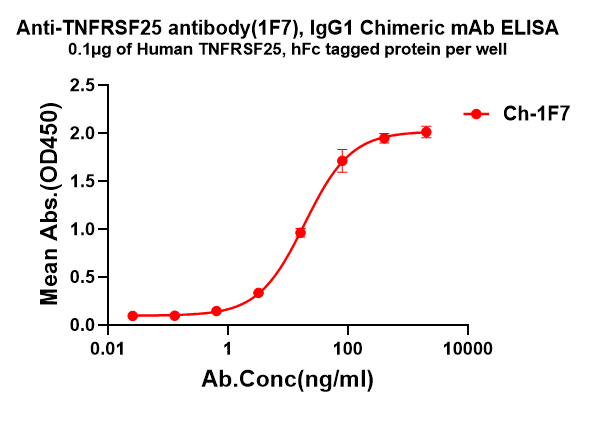
| Applications | ELISA, Flow Cyt |
| Recommended Dilutions | ELISA 1/5000-10000;Flow Cyt 1/100 |
| Purification | Purified from cell culture supernatant by affinity chromatography |
| Endotoxin | Less than 1.0 EU/μg by the LAL method. For <1 EU/mg requirements, please contact us for customization. |
| Formulation & Reconstitution | Powder |
| Storage&Shipping | Store at -20°C to -80°C for 12 months in lyophilized form. After reconstitution, if not intended for use within a month, aliquot and store at -80°C (Avoid repeated freezing and thawing). |
| Sterility | Products are supplied non-sterile. For cell culture applications, dilute in appropriate medium and sterile-filter (0.22 µm) prior to use. |
| Background | The protein encoded by this gene is a member of the TNF-receptor superfamily. This receptor is expressed preferentially in the tissues enriched in lymphocytes, and it may play a role in regulating lymphocyte homeostasis. This receptor has been shown to stimulate NF-kappa B activity and regulate cell apoptosis. The signal transduction of this receptor is mediated by various death domain containing adaptor proteins. Knockout studies in mice suggested the role of this gene in the removal of self-reactive T cells in the thymus. Multiple alternatively spliced transcript variants of this gene encoding distinct isoforms have been reported, most of which are potentially secreted molecules. The alternative splicing of this gene in B and T cells encounters a programmed change upon T-cell activation, which predominantly produces full-length, membrane bound isoforms, and is thought to be involved in controlling lymphocyte proliferation induced by T-cell activation. [provided by RefSeq, Jul 2008] |
| Usage | Research use only |
| Conjugate | Unconjugated |

服务热线
400-006-0995
18062749453