
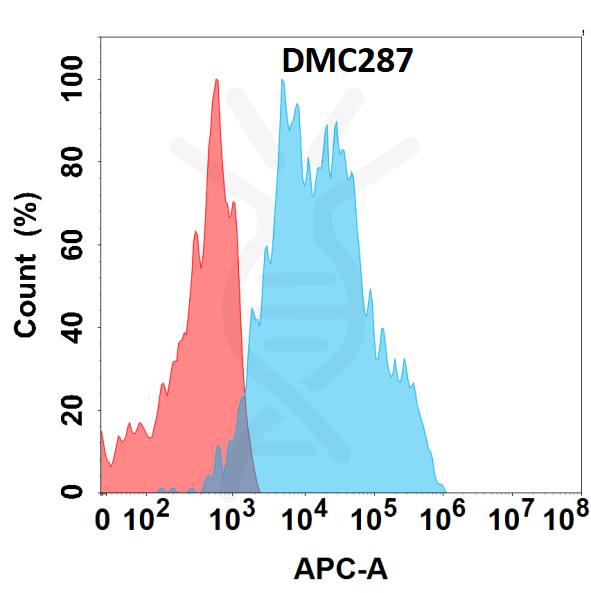
| Clone ID | DMC287 |
|---|---|
| Target | |
| Immunogen | PME100079 |
| Synonyms | NKG2D;CD314;KLRK1;NK cell receptor D |
| Host Species | Rabbit |
| Description | Anti-NKG2D antibody(DMC287); IgG1 Chimeric mAb |
| Delivery | In Stock |
| Uniprot ID | P26718 |
| IgG type | Rabbit/Human Fc chimeric IgG1 |
| Clonality | Monoclonal |
| Reactivity | Human |
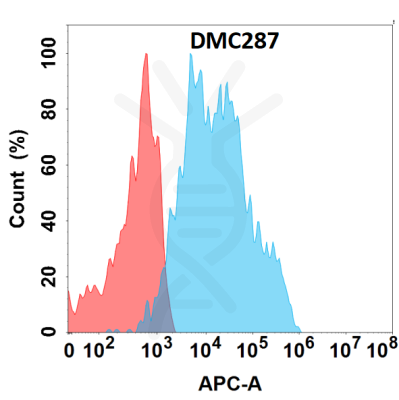
| Applications | Flow Cyt |
| Recommended Dilutions | Flow Cyt 1:100 |
| Purification | Purified from cell culture supernatant by affinity chromatography |
| Endotoxin | Less than 1.0 EU/μg by the LAL method. For <1 EU/mg requirements, please contact us for customization. |
| Formulation & Reconstitution | Lyophilized from sterile PBS, pH 7.4. Normally 5 % – 8% trehalose is added as protectants before lyophilization. Please see Certificate of Analysis for specific instructions of reconstitution. |
| Storage&Shipping | Store at -20°C to -80°C for 12 months in lyophilized form. After reconstitution, if not intended for use within a month, aliquot and store at -80°C (Avoid repeated freezing and thawing). Lyophilized proteins are shipped at ambient temperature. |
| Sterility | Products are supplied non-sterile. For cell culture applications, dilute in appropriate medium and sterile-filter (0.22 µm) prior to use. |
| Background | Natural killer (NK) cells are lymphocytes that can mediate lysis of certain tumor cells and virus-infected cells without previous activation. They can also regulate specific humoral and cell-mediated immunity. NK cells preferentially express several calcium-dependent (C-type) lectins; which have been implicated in the regulation of NK cell function. The NKG2 gene family is located within the NK complex; a region that contains several C-type lectin genes preferentially expressed in NK cells. This gene encodes a member of the NKG2 family. The encoded transmembrane protein is characterized by a type II membrane orientation (has an extracellular C terminus) and the presence of a C-type lectin domain. It binds to a diverse family of ligands that include MHC class I chain-related A and B proteins and UL-16 binding proteins; where ligand-receptor interactions can result in the activation of NK and T cells. The surface expression of these ligands is important for the recognition of stressed cells by the immune system; and thus this protein and its ligands are therapeutic targets for the treatment of immune diseases and cancers. Read-through transcription exists between this gene and the upstream KLRC4 (killer cell lectin-like receptor subfamily C; member 4) family member in the same cluster. |
| Usage | Research use only |
| Conjugate | Unconjugated |
| DIMA Disclaimer | All DIMA recombinant antibodies are genuinely generated by DIMA Biotech. They are all under patent application. Any protein sequencing or reverse engineering attempt is prohibited. We are actively scr |


服务热线
400-006-0995
18062749453